
High-accuracy imaging with Detectnet can help guide treatment decisions1,2


Positron Range
64Cu’s short positron range plays a role in high-accuracy imaging2
64Cu has a short positron range; it generates photons that are close to their emission source, which can lead to high spatial resolutiona and, therefore, clear image quality and detection of small and adjacent lesions.2-5
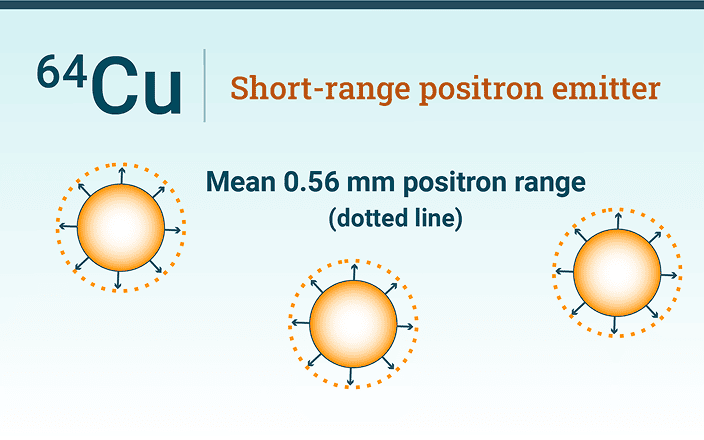
aSpatial resolution determines how detailed an object is represented and allows 2 adjacent objects to be differentiated in an image.5
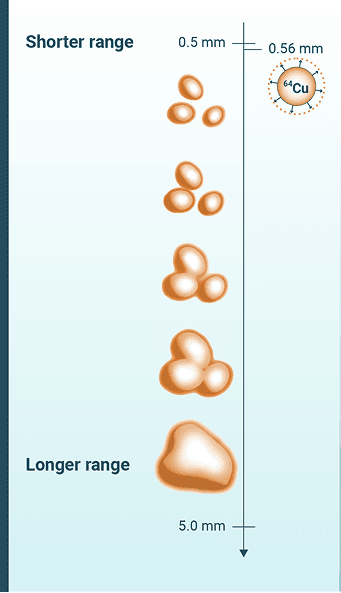
- Shorter positron range: Supports clearer separation of small and adjacent lesions2
- Longer positron range: The signal from the 3 lesions may merge into a single image2
Why this matters:

NET lesions are often small. 64Cu supports accurate lesion detection.1,2
Abbreviation: NET, neuroendocrine tumor.
See how 64Cu’s short positron range may help visualize small, adjacent tumors.2,5


Efficacy
Detectnet yields high-quality images to help accurately diagnose your patients2,6
Phase 3, prospective, single-arm PET/CT study (Delpassand 2020)2,6
High-quality images with a high rate of accuracy2
100%
(88.7% TO 100%)
96.8%
(84.3% TO 99.5%)
96.7%
(83.8% TO 99.4%)
100%
(89.3% TO 100%)
98.4%
(91.4% TO 99.7%)
Confidence intervals are in parentheses.
bStatistical analysis plan included testable hypothesis for coprimary endpoints (ie, sensitivity and specificity). Thus, P values were calculated for sensitivity and specificity and not for PPV, NPV, or accuracy.
Abbreviations: CT, computed tomography; IV, intravenous; NPV, negative predictive value; PET, positron emission tomography; PPV, positive predictive value.
Study design2,6
This open-label, single-center study evaluated the diagnostic performance and safety of Detectnet PET/CT imaging in 63 participants (42 patients with known or suspected NETs and 21 healthy volunteers). Detectnet results, read by blinded experts, were compared with a reference standard based on an independent expert’s assessment of conventional imaging and clinical and laboratory data. PET/CT scans were taken ~60 minutes after a single IV dose of 148 MBq ± 10% of Detectnet.
Considerations: The reference standard incorrectly identified 3 NET-negative cases as NET positive. Because the objective of the study was to assess the performance of the PET/CT scan and not the reference standard, the corrected values are shown.
The clear, sensitive imaging of Detectnet enables you to confidently differentiate between local and metastatic lesions2





Delpassand 2020 demonstrated sensitivity and specificity of 100% to differentiate between localized and metastatic disease.2
Inclusion of a large population of NET-negative subjects increases confidence in the ability of Detectnet to exclude disease.2
Why this matters:
High-accuracy imaging with Detectnet can help you obtain a clear patient picture and determine the right treatment plan.1,2
Comparing the diagnostic performance of copper Cu 64 dotatate PET with 111In-DTPA-octreotide SPECT7
Open-label, single-center comparative study (Pfeifer 2015)6,7
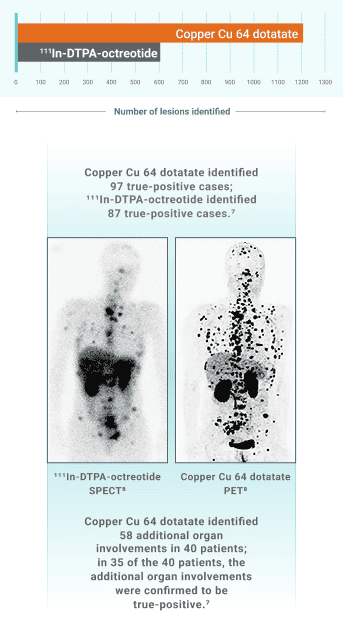
Copper Cu 64 dotatate detected 1213 lesions and 111In-DTPA-octreotide detected 603. This study was designed to evaluate routine implementation of copper Cu 64 dotatate and not to assess superiority.7
Watch how copper Cu 64 dotatate PET compares with 111In-DTPA-octreotide SPECT, and how higher-resolution PET imaging may improve lesion detection in NETs.

Diagnostic performance of copper Cu 64 dotatate and 111In-DTPA-octreotide7
97%
(91% to 99%)
87%
(79% to 92%)
100%
(96% to 100%)
100%
(96% to 100%)
97%
(92% to 99%)
88%
(81% to 93%)
100%
(97% to 100%)
100%
(96% to 100%)
80%
(54% to 94%)
48%
(30% to 67%)
aP=.017; copper Cu 64 dotatate vs 111In-DTPA-octreotide (McNemar test for paired proportions).
bAt prevalence of disease of 89%.
Numbers in parentheses are 95% confidence intervals calculated using adjusted Wald method.
Study design6,7
A single-dose study evaluating the diagnostic performance of copper Cu 64 dotatate versus 111In-DTPA-octreotide (kit for the preparation of indium In 111 pentetreotide) in 112 patients with confirmed gastroenteropancreatic or pulmonary NETs. PET scans were acquired 1 hour after injection of 202 MBq of copper Cu 64 dotatate after diagnostic contrast-enhanced CT scan. Detectnet is FDA-approved for a dose of 148 MBq.
The study did not include a histopathological standard of truth.
Abbreviation: SPECT, single-photon emission computed tomography.
A head-to-head study with gallium Ga 68 dotatoc demonstrated copper Cu 64 dotatate's high lesion detection rate.1
Prospective, open-label, head-to-head PET/CT study (Johnbeck 2017)1
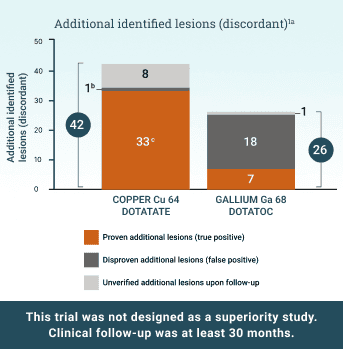
aThe patient-level diagnostic performance was the same for both tracers because they were both able to identify matching lesions in patients where additional lesions were also identified. A total of 701 matching (concordant) lesions were identified.
bReported significant, but no P value included.
cP<.001.
The authors concluded that “the difference in lesion detection rate found in the current study is presumed to relate to use of 64Cu instead of 68Ga rather than to differences in peptide.”1
Study design1,6
This single-center European study compared the diagnostic performance of copper Cu 64 dotatate PET/CT with gallium Ga 68 dotatoc PET/CT. Patients (n=59) with a history of NETs were scanned with both copper Cu 64 dotatate and gallium Ga 68 dotatoc PET/CT within 1 week of each other. A 200-MBq injection of copper Cu 64 dotatate was administered intravenously, and PET/CT was performed after 60 minutes. A 150-MBq injection of gallium Ga 68 dotatoc was administered intravenously, and PET/CT was performed after 45 minutes. A limitation was the acquisition of a diagnostic CT scan with only copper Cu 64 dotatate PET; however, the lesion-to-lesion comparison in the study mitigated this concern. Detectnet is FDA-approved for a dose of 148 MBq.
Regions1
Concordant and true-positive discordant lesions1
dBreast (10), ovary (2), adrenal gland (1), soft tissue (3).
eData are estimates.
Discordant lesions found by copper Cu 64 dotatate were located in bones, liver, lymph nodes, pancreas, or soft tissue, or were carcinomatosis.
Patients1
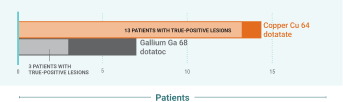
Among discordant lesions, copper Cu 64 dotatate revealed 13 out of 14 patients (P=.013) with true-positive lesions. Gallium Ga 68 dotatoc revealed 3 out of 8 patients with true-positive lesions.
Why this matters:
High lesion detection supports clear visualization of NETs, helping reduce uncertainty when assessing disease extent and informing clinical decisions.1
Case Study
Theranostic pairing with lutetium Lu 177 dotatate
Detectnet can be used to determine eligibility for radioligand therapy (RLT) and to assess treatment response.9
Detectnet and lutetium Lu 177 dotatate both incorporate the ligand dotatate, which binds to somatostatin receptors with highest affinity for subtype 2 receptors.6,10 This mechanistic alignment allows for comparable distribution to NETs, which makes Detectnet an appropriate theranostic partner for lutetium Lu 177 dotatate.6,7,9,10

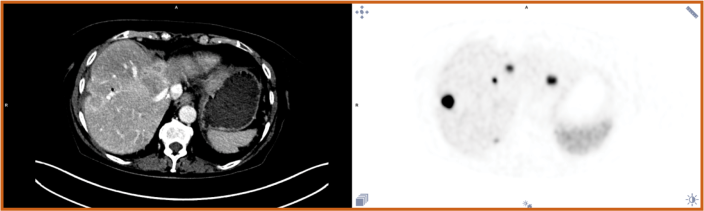
A patient with a metastatic pancreatic G2 NET (Ki-67: 15%) previously had a primary tumor resected11
Pre-RLT imaging: A copper Cu 64 dotatate scan before RLT revealed high uptake and confirmed eligibility for lutetium Lu 177 dotatate RLT11
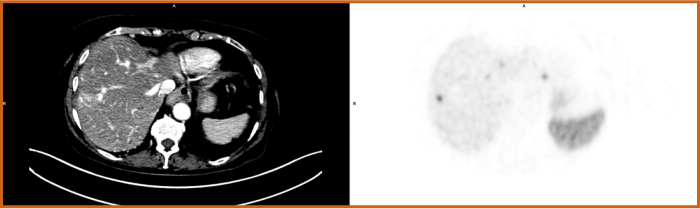
RLT: The patient was treated with 4 doses of lutetium Lu 177 dotatate (total dose 792 mCi)11
Post-RLT imaging: A copper Cu 64 dotatate scan 1 year later showed a partial response to therapy, with lower uptake and fewer lesions in the liver11
Q&A
What are the differences in positron ranges between 64Cu and 68Ga?
64Cu has a shorter positron range than 68Ga (0.56 mm vs 3.5 mm).2
What clinical information is available comparing copper Cu 64 dotatate and gallium Ga 68 dotatoc?
Copper Cu 64 dotatate and gallium Ga 68 dotatoc were evaluated in a prospective, open-label, single-center, head-to-head study in 59 patients with NETs. The study assessed diagnostic performance, including lesion detection rate. This trial was not designed as a superiority study.
Watch Dr Aman Chauhan discuss how PET imaging with Detectnet helps identify somatostatin receptor–positive lesions and supports treatment planning


Request a Rep


IMPORTANT SAFETY INFORMATION
WARNINGS AND PRECAUTIONS
Radiation Risk:
Diagnostic radiopharmaceuticals, including Detectnet, contribute to a patient’s overall long-term cumulative radiation exposure. Long-term cumulative radiation exposure is associated with an increased risk of cancer. Ensure safe handling and preparation procedures to protect patients and health care workers from unintentional radiation exposure. Advise patients to hydrate before and after administration and to void frequently after administration.
Hypersensitivity Reactions:
Hypersensitivity reactions following administration of somatostatin receptor imaging agents predominantly consisted of cutaneous reactions such as rash and pruritus. Reactions reversed either spontaneously or with routine symptomatic management. Less frequently hypersensitivity reactions included angioedema or cases with features of anaphylaxis.
Risk for Image Misinterpretation:
The uptake of copper Cu 64 dotatate reflects the level of somatostatin receptor density in NETs, however, uptake can also be seen in a variety of other tumors that also express somatostatin receptors. Increased uptake might also be seen in other non-cancerous pathologic conditions that express somatostatin receptors including thyroid disease or in subacute inflammation, or might occur as a normal physiologic variant (e.g., uncinate process of the pancreas).
A negative scan after the administration of Detectnet in patients who do not have a history of NET disease does not rule out disease.
ADVERSE REACTIONS
In clinical trials, adverse reactions occurred at a rate of < 2% and included nausea, vomiting and flushing. In published trials nausea immediately after injection was observed.
DRUG INTERACTIONS
Somatostatin Analogs:
Non-radioactive somatostatin analogs and copper Cu 64 dotatate competitively bind to somatostatin receptors (SSTR2). Image patients just prior to dosing with somatostatin analogs. For patients on long-acting somatostatin analogs, a washout period of 28 days is recommended prior to imaging. For patients on short-acting somatostatin analogs, a washout period of 2 days is recommended prior to imaging.
USE IN SPECIFIC POPULATIONS
Pregnancy:
All radiopharmaceuticals, including Detectnet have the potential to cause fetal harm depending on the fetal stage of development and the magnitude of the radiation dose. Advise a pregnant woman of the potential risks of fetal exposure to radiation from administration of Detectnet.
Lactation:
Advise a lactating woman to interrupt breastfeeding for 12 hours after Detectnet administration in order to minimize radiation exposure to a breastfed infant.
Pediatric Use:
The safety and effectiveness of Detectnet have not been established in pediatric patients.
Geriatric Use:
In general, dose selection for an elderly patient should be cautious, usually starting at the low end of the dosing range, reflecting the greater frequency of decreased hepatic, renal, or cardiac function, and of concomitant disease or other drug therapy.
OVERDOSAGE
In the event of a radiation overdose, the absorbed dose to the patient should be reduced where possible by increasing the elimination of the radionuclide from the body by reinforced hydration and frequent bladder voiding. A diuretic might also be considered.
INDICATIONS AND USAGE
Detectnet is indicated for use with positron emission tomography (PET) for localization of somatostatin receptor positive neuroendocrine tumors (NETs) in adult patients.
Back to top
References
- Johnbeck CB, Knigge U, Loft A, et al. Head-to-head comparison of 64Cu-DOTATATE and 68Ga-DOTATOC PET/CT: a prospective study of 59 patients with neuroendocrine tumors. J Nucl Med. 2017;58(3):451-457. doi:10.2967/jnumed.116.180430
- Delpassand ES, Ranganathan D, Wagh N, et al. 64Cu-DOTATATE PET/CT for imaging patients with known or suspected somatostatin receptor–positive neuroendocrine tumors: results of the first U.S. prospective, reader-masked clinical trial. J Nucl Med. 2020;61(6):890-896. doi:10.2967/jnumed.119.236091
- Conti M, Eriksson L. Physics of pure and non-pure positron emitters for PET: a review and a discussion. EJNMMI Phys. 2016;3(1):8. doi:10.1186/s40658-016-0144-5
- Alva-Sánchez H, Quintana-Bautista C, Martínez-Dávalos A, Ávila-Rodríguez MA, Rodríguez-Villafuerte M. Positron range in tissue-equivalent materials: experimental microPET studies. Phys Med Biol. 2016;61(17):6307-6321. doi:10.1088/0031-9155/61/17/6307
- Schäfers KP. The promise of nuclear medicine technology: status and future perspective of high-resolution whole-body PET. Phys Med. 2008;24(2):57-62. doi:10.1016/j.ejmp.2008.01.008
- Detectnet. Prescribing information. Curium US LLC; January 2025.
- Pfeifer A, Knigge U, Binderup T, et al. 64Cu-DOTATATE PET for neuroendocrine tumors: a prospective head-to-head comparison with 111In-DTPA-octreotide in 112 patients. J Nucl Med. 2015;56(6):847-854. doi:10.2967/jnumed.115.156539
- Pfeifer A, Knigge U, Mortensen J, et al. Clinical PET of neuroendocrine tumors using 64Cu-DOTATATE: first-in-humans study. J Nucl Med. 2012;53(8):1207-1215. doi:10.2967/jnumed.111.101469
- Hope TA, Bergsland EK, Bozkurt MF, et al. Appropriate use criteria for somatostatin receptor PET imaging in neuroendocrine tumors. J Nucl Med. 2018;59(1)(suppl):66-74. doi:10.2967/jnumed.117.202275
- Lutathera. Prescribing information. Novartis AG; October 2024.
- Data on file. Curium US LLC.

