
Detectnet makes planning, scheduling, and dosing more convenient1,2


Scheduling
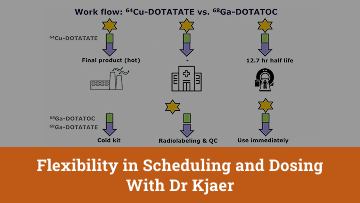
The 12.7-hour half-life of 64Cu makes Detectnet a practical and reliable solution for SSTR PET imaging1
Detectnet
(copper Cu 64 dotatate)3
Physical half-life: 12.7 hours


Operational Impact
Daily centralized production and distribution, not dependent on a generator schedule1,5
Ready-made doses3,4
Supplied in unrestricted quantities per day1,6
Gallium Ga 68 dotatate4
Physical half-life: 1.1 hours

Abbreviation: SSTR, somatostatin receptor.
Detectnet provides flexibility in scheduling and dosing1-3

Fewer lost doses due to patient or staff delays1,2
Maintains dose viability over a wider dosing and imaging window to help minimize time-sensitive workflow disruptions such as delays or patient cancellations

Streamlined dose preparation and administration3
Ready-made doses—no cold-kit preparation—to help simplify workflow, reduce preparation time, and support efficient patient throughput (more scans per day)3,5,6

Centralized production1,6
Reliable, on-demand supply nationwide in unrestricted quantities without generator constraints or dose-per-elution limits
Explore how the 12.7-hour half-life of 64Cu supports flexible scheduling and the advantages of cyclotron production.


Dosing & Administration
Ready-made doses allow for quick and simple preparation3
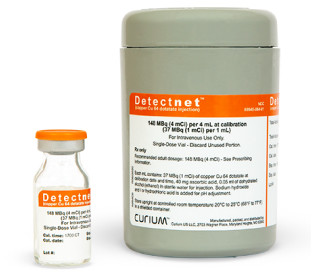
Detectnet is supplied in single-dose vials.3
In adults, the recommended dose of Detectnet is 4 mCi (148 MBq), providing an effective radiation dose of 4.7 mSv.3
Detectnet should be administered as an intravenous injection over 1 minute, adhering to appropriate radiation safety measures.3 All vials of Detectnet will contain an activity of 4 mCi at 1700 CST with an expiration of 1900 CST.3 Therefore, there is enough drug activity in the vial at day of administration from the earliest morning appointment until the end of the work day.
Detectnet Ordering Information
Ready to order? The 12.7-hour half-life of 64Cu allows for wide distribution of Detectnet on demand1
Detectnet is produced in a central location using a cyclotron—no generator required.1
- Reliable, on-demand supply nationwide, with unrestricted quantities1,6
- Order and receive doses when you need them
To order, contact your Curium representative or call customer service at 888-744-1414, Monday through Friday, 7 AM to 5 PM CT.
Refer to the information below for product details and ordering deadlines when placing your order. Please note that the product ships Sunday through Thursday to allow for patient use Monday through Friday. While placing your order, be sure to ask about additional availability of Detectnet.
Q&A
How does production of copper Cu 64 dotatate differ from Gallium Ga 68 dotatate?
Unlike Gallium Ga 68 dotatate, copper Cu 64 dotatate uses daily centralized production and distribution, and is not dependent on a generator schedule.1,5
Are there differences in how copper Cu 64 dotatate and Gallium Ga 68 dotatate are prepared?
With copper Cu 64 dotatate, there is no kit preparation required,3 which helps simplify workflows and support efficient patient throughput.3,5,6
How does the half-life of copper Cu 64 dotatate compare with Gallium Ga 68 dotatate in supporting practice workflows?
The 12.7‑hour half-life of copper Cu 64 dotatate helps maintain dose viability over a wider dosing and imaging window, minimizing time-sensitive workflow disruptions.1,2

Request a Rep


IMPORTANT SAFETY INFORMATION
WARNINGS AND PRECAUTIONS
Radiation Risk:
Diagnostic radiopharmaceuticals, including Detectnet, contribute to a patient’s overall long-term cumulative radiation exposure. Long-term cumulative radiation exposure is associated with an increased risk of cancer. Ensure safe handling and preparation procedures to protect patients and health care workers from unintentional radiation exposure. Advise patients to hydrate before and after administration and to void frequently after administration.
Hypersensitivity Reactions:
Hypersensitivity reactions following administration of somatostatin receptor imaging agents predominantly consisted of cutaneous reactions such as rash and pruritus. Reactions reversed either spontaneously or with routine symptomatic management. Less frequently hypersensitivity reactions included angioedema or cases with features of anaphylaxis.
Risk for Image Misinterpretation:
The uptake of copper Cu 64 dotatate reflects the level of somatostatin receptor density in NETs, however, uptake can also be seen in a variety of other tumors that also express somatostatin receptors. Increased uptake might also be seen in other non-cancerous pathologic conditions that express somatostatin receptors including thyroid disease or in subacute inflammation, or might occur as a normal physiologic variant (e.g., uncinate process of the pancreas).
A negative scan after the administration of Detectnet in patients who do not have a history of NET disease does not rule out disease.
ADVERSE REACTIONS
In clinical trials, adverse reactions occurred at a rate of < 2% and included nausea, vomiting and flushing. In published trials nausea immediately after injection was observed.
DRUG INTERACTIONS
Somatostatin Analogs:
Non-radioactive somatostatin analogs and copper Cu 64 dotatate competitively bind to somatostatin receptors (SSTR2). Image patients just prior to dosing with somatostatin analogs. For patients on long-acting somatostatin analogs, a washout period of 28 days is recommended prior to imaging. For patients on short-acting somatostatin analogs, a washout period of 2 days is recommended prior to imaging.
USE IN SPECIFIC POPULATIONS
Pregnancy:
All radiopharmaceuticals, including Detectnet have the potential to cause fetal harm depending on the fetal stage of development and the magnitude of the radiation dose. Advise a pregnant woman of the potential risks of fetal exposure to radiation from administration of Detectnet.
Lactation:
Advise a lactating woman to interrupt breastfeeding for 12 hours after Detectnet administration in order to minimize radiation exposure to a breastfed infant.
Pediatric Use:
The safety and effectiveness of Detectnet have not been established in pediatric patients.
Geriatric Use:
In general, dose selection for an elderly patient should be cautious, usually starting at the low end of the dosing range, reflecting the greater frequency of decreased hepatic, renal, or cardiac function, and of concomitant disease or other drug therapy.
OVERDOSAGE
In the event of a radiation overdose, the absorbed dose to the patient should be reduced where possible by increasing the elimination of the radionuclide from the body by reinforced hydration and frequent bladder voiding. A diuretic might also be considered.
INDICATIONS AND USAGE
Detectnet is indicated for use with positron emission tomography (PET) for localization of somatostatin receptor positive neuroendocrine tumors (NETs) in adult patients.
Back to top
References
- Delpassand ES, Ranganathan D, Wagh N, et al. 64Cu-DOTATATE PET/CT for imaging patients with known or suspected somatostatin receptor–positive neuroendocrine tumors: results of the first U.S. prospective, reader-masked clinical trial. J Nucl Med. 2020;61(6):890-896. doi:10.2967/jnumed.119.236091
- Hope TA, Allen-Auerbach M, Bodei L, et al. SNMMI procedure standard/EANM practice guideline for SSTR PET: imaging neuroendocrine tumors. J Nucl Med. 2023;64(2):204-210. doi:10.2967/jnumed.122.264860
- Detectnet. Prescribing information. Curium US LLC; January 2025.
- Netspot. Prescribing information. Advanced Accelerator Applications USA, Inc.; 2023.
- Pfeifer A, Knigge U, Binderup T, et al. 64Cu-DOTATATE PET for neuroendocrine tumors: a prospective head-to-head comparison with 111In-DTPA-octreotide in 112 patients. J Nucl Med. 2015;56(6):847-854. doi:10.2967/jnumed.115.156539
- Lepareur N. Cold kit labeling: the future of 68Ga radiopharmaceuticals? Front Med (Lausanne). 2022;9:812050. doi:10.3389/fmed.2022.812050
